
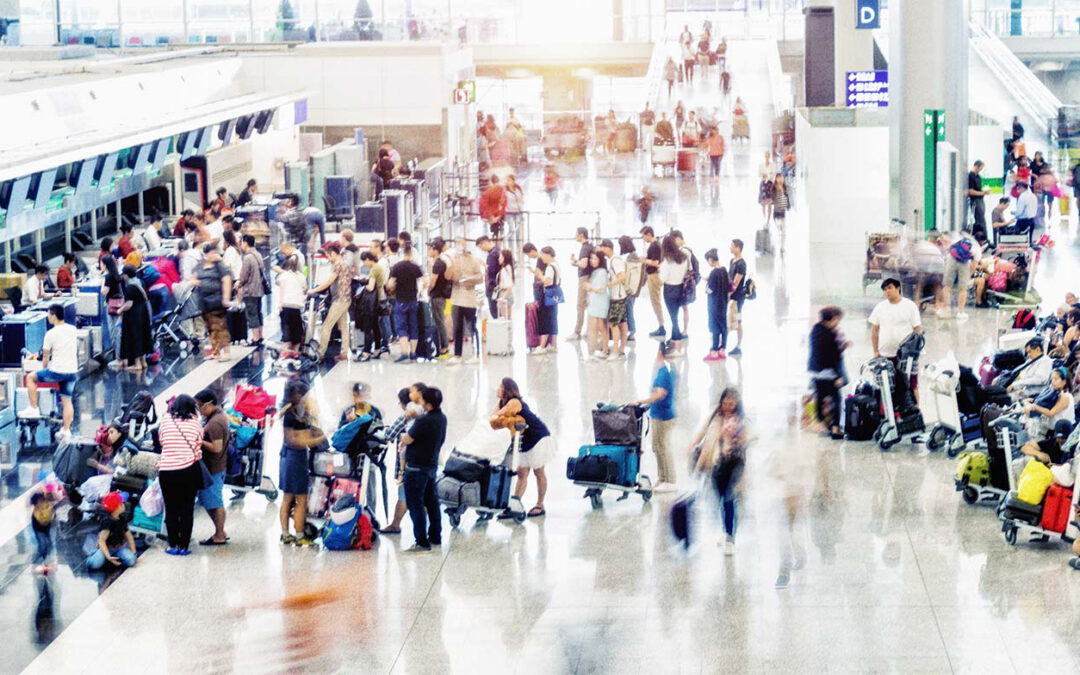
Juniper projects that digital travel credentials will reach 1.2 billion passengers by 2035, and names Indicio one of 13 vendors poised to lead the market.
By Helen Garneau
A new study, Digital Travel Credential Market 2026-2035, by Juniper Research predicts that 1.2 billion passengers will use a digital travel credential by 2035, up from 105 million in 2027, over 1,000 percent growth in eight years. The report includes 90 forecast tables and over 72,500 data points covering aviation, land borders, rail, and maritime sectors. It also features an independent Competitor Leaderboard that evaluates 13 top digital travel credential vendors on their ability to compete.
Indicio is one of those 13.
What the report means for airlines, airports, and borders
Beyond the headline figure, the report highlights the themes of pressure and speed. Passengers are supplying the pressure, with Juniper linking long-term adoption directly to frustrations over manual checks and complex programs like Europe’s Entry/Exit System.
IATA surveys already reflect this demand, with 78 percent of travelers wanting a single smartphone credential to handle booking, payment, and all touchpoints from check-in to boarding. Passengers are explicitly requesting the OneID journey the industry has been promising for years.
The pace is where it becomes interesting for anyone developing strategy. Juniper does not anticipate a fully digital journey before 2040, meaning that even with a digital travel credential, a passenger will still have to carry their physical passport as a backup until then.
The key business takeaway? The specifications and standards are largely agreed upon or are currently being worked out in pilots, and the technology is also rolling out in real world deployments; the trust frameworks — the governance that enables carriers and countries to verify digital travel credentials from different issuers — is a work in progress. The speed at which that happens will affect the pace of adoption.
Why Indicio is on the leaderboard
In March 2023, a traveler landed in Aruba, looked into a camera, and cleared immigration instantly. No passport line. No manual document check. It was the world’s first digital travel credential used at a live border. Built by Indicio with SITA and the Government of Aruba, the credential aligned with the International Civil Aviation Organization’s specifications for a Type One Digital Travel Credential (ICAO DTC-1).
This meant that a traveler was able to derive a digital travel credential from their passport by scanning the passport document and reading the embedded chip, taking a liveness video, submitting the data for validation and face-matching and then receiving a digital credential with that data — including their biometric — and storing it in a digital wallet on their phone.
The information in the credential was digitally signed, meaning it was tamper-evident and could be shared selectively. The issuer of the credential — an airline — could be proven instantly by the same cryptography. The credential could be reused over and over again and across disparate systems, as proof traveled with it.
The most far-reaching breakthrough was that the traveler could bring their own biometrics with them. Bound to their credential and device, they could present an authenticated copy of their biometrics for checking against their live image. This had enormous infrastructural, compliance, and security signficance: it meant you didn’t need to store biometric data to verify it; it meant you had a simple way to counter the sudden emergence of AI-generated deepfakes.
Indicio also showed how to combine different credential formats in a single passenger workflow, a vital step in a world where no single credential format for travel is likely to dominate in the near future.
And finally, Indicio has developed credentials that align with ICAO’s (not quite complete) specifications for government-issued digital travel credentials (DTC-2), which will see country-level deployment by the end of 2026. Indicio is also participating in the EU’s APTITUDE Large Scale Pilot for testing DTC-2 type credentials.
The decision in front of you
ICAO projects 12.4 billion air passengers a year by 2050. No one is pouring terminal concrete fast enough to move that volume. Digital travel credentials are critical to meeting that capacity by prechecking more passengers and moving them through frictionless infrastructure like contactless corridors.
But digital travel credentials are more than just about air travel. They can be deployed to meet the need of seamless biometric authentication for rail, sea, and any border. They can enable biometric baggage management, car hire, and hotel check-in. They can be used for seamless proof of payment.
For more, read our recent market briefing on what the future of travel will look and feel like — and if you want to get there fast contact Indicio and we’ll show you just how amazing this technology is and how quickly you can deploy it.
Indicio makes proving identity simple. It gives people a faster way to prove who they are, and gives the organizations that serve them a cheaper, safer way to be sure. Indicio is an analyst award-winning company serving customers across travel, banking, hiring, and government, in production at national scale today.